

In less than three months, Google’s AI Mode went from an opt-in feature in Search Labs to the newest member of the Google Search experience. Now, users can have an end-to-end AI search experience.
But, what does that mean for marketers and search engine optimization (SEO)? It means a new chapter in how businesses get discovered, build connections, and drive revenue has started — and that search everywhere optimization is here.
P.S. Keep a pulse on the latest shifts in AI search by joining Revenue Weekly!
What is Google AI Mode?
Google AI Mode is an end-to-end AI search experience similar to Microsoft Copilot, ChatGPT, and other generative search engines. Users can ask initial and follow-up questions, as well as visit provided links for deeper exploration.
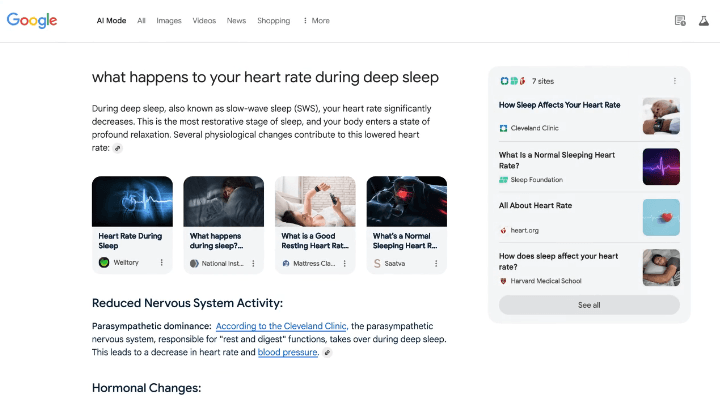
A custom version of Google’s Gemini 2.5 model powers AI Mode.
How does AI Mode work?
You can look at how AI Mode works two ways:
- Capabilities
- Functionality
As an SEO, it’s critical to understand both areas:
Capabilities
The capabilities of Google’s AI Mode include:
| Capability | Use case |
| Deep Search | Get an expert report with citations on a specific topic (similar to Deep Research in Gemini) |
| Live | Get answers using audio and video simultaneously (and Google’s Project Astra capabilities) |
| Agentic | Get a virtual assistant for completing tasks, from purchasing tickets to completing forms |
| Shopping | Get help finding — and even trying on — products and pair the assistance with AI Mode’s Agentic capabilities |
| Personal context | Get personalized answers based on your Google apps, like Gmail, Google Drive, and more |
Functionality
From a functionality perspective, Google AI Mode works using the company’s query fan-out technique, which takes a question and slices it into subtopics, which AI Mode then uses as queries to generate an answer.
It’s similar to taking a pizza, slicing it, and then determining its ingredients.
How does AI Mode compare to AI Overviews?
When it comes to comparing AI Mode to AI Overviews, it’s all in the name. AI Mode is an end-to-end search experience similar to ChatGPT where its design encourages users to remain within the experience.
In comparison, AI Overviews are more open-ended (though click-through rates drop by more than 34% when they’re present) by displaying above the familiar organic search results.
The biggest difference between AI Mode and AI Overviews is AI Mode is a search mode while AI Overviews is a search feature. Additional similarities and differences include:
| Factor | AI Mode | AI Overviews |
| Source citations | ✓ | ✓ |
| Traditional organic search result listings | ✕ | ✓ |
| Ads | ✓ | ✓ |
| Analytics | Limited | Limited |
How does AI Mode impact SEO?
AI Mode impacts SEO in a few ways, including:
Tracking
While Google Search Console receives impression and click data from AI Mode, it doesn’t provide an option for viewing this specific data. Instead, it’s tracked under the “Web” search type.
For SEOs, this setup makes tracking AI Mode touchpoints challenging. While SEOs can share Google’s findings that AI-generated results produce more qualified website visits, they can’t do it with their own data.
Visibility
Like AI Overviews, AI Mode impacts a website’s visibility. Instead of appearing within, alongside, and/or below an AI Overview in the traditional search results, AI Mode’s search real estate is constrained to its:
- Answer
- Sidebar
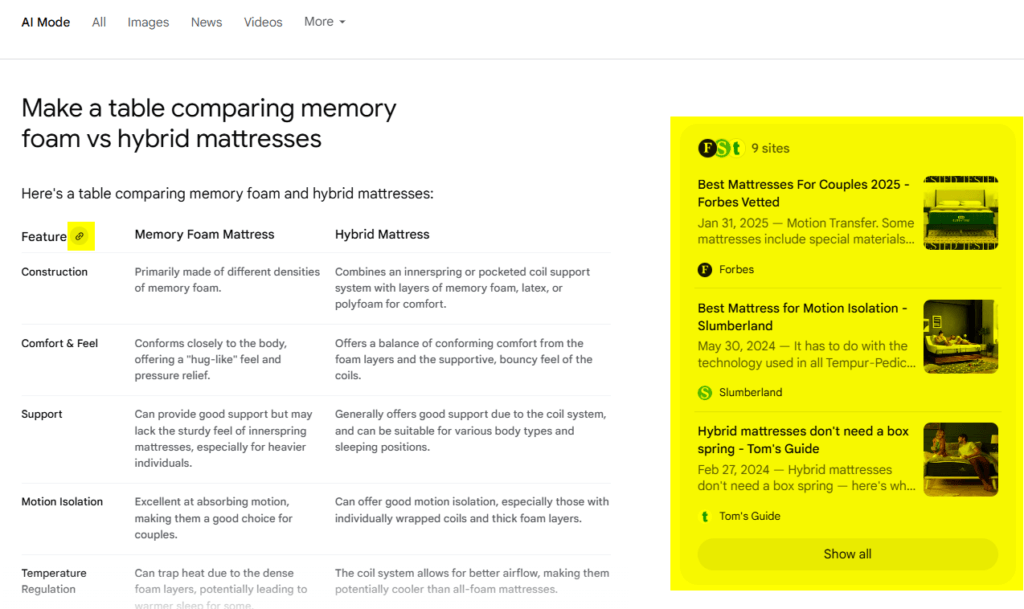
For businesses, this design creates fewer moments to capture a user’s attention and create a touchpoint, which impacts one of the goals of search: Building brand visibility.
Traffic
AI Mode will impact one of SEO’s hallmark metrics: Traffic.
While traffic can serve as a vanity metric, it’s still an important metric in the story of achieving a business’s goals, whether that’s generating more online leads or processing more online sales.
Because AI Mode is similar to the user experience of AI chatbots like ChatGPT, people are less likely to visit the cited sites, with one study finding that AI chatbots send 96% less referral traffic than traditional search.
While most industries saw the impact of AI Overviews instantly, it’s unlikely businesses will see the immediate impact of AI Mode because it’s not integrated into the traditional search experience like AI Overviews.
Expert insights from Google
“AI Mode is…also a glimpse of what’s to come. As we get feedback, we’ll graduate many features and capabilities from AI Mode right into the core Search experience.”
Users need to change their behavior to use AI Mode, which operates in a separate tab, like Image search. However, Google has stated it plans to bring elements of AI Mode to traditional search.
Strategy
One of the biggest impacts of AI Mode on SEO is strategy. While foundational SEO is still core to appearing in AI search experiences, businesses need to adapt for what comes after that.
These adaptations include:
- The targeted search intents
- The written and visual quality of content
- The metrics used to measure SEO success
- The scope of targeted search experiences
Mastering these adaptations is essential for building a successful and future-proof strategy for AI and SEO.
You can learn more about these shifts below:
How should SEOs respond to Google’s AI Mode?
Proactively.
While no one knows when AI Mode will come to traditional search, we do know Google is moving fast to re-capture the AI search market — as demonstrated by the speed at which AI Mode went from Labs to Live.
Not to mention, how people are finding information online is changing.
From our own research, we’ve found that AI search is growing 165x faster than organic search (though its total share of website traffic is less than 1%). That’s a strong indicator for SEOs to proactively:
- Rethink how you measure success
- Optimize across search channels (i.e. OmniSEO™)
- Adapt faster than the competition
1. Rethinking how you measure success
Redefining performance metrics has been an ongoing conversation, whether due to ChatGPT’s 800-million-plus user base or AI Overviews’ impact on click-through-rates (CTRs), which decrease by 34.5%.
SEOs (and business leaders) need to rethink traffic’s role in measuring success, because in a lot of cases, companies are seeing their traffic decrease and revenue increase:
- NerdWallet, which grew its revenue 29% YoY for Q1 of 2025 against traffic losses.
- HubSpot, which grew its annual revenue 21% in 2024 against a rumored 80% traffic loss.
This doesn’t mean businesses should ignore traffic numbers, but instead take them into consideration with other metrics, like online visibility, conversions, leads, and sales.
Google has acknowledged this shift as well, stating, “Consider looking at various indicators of conversion on your site, be it sales, signups, a more engaged audience, or information lookups about your business.”
Like any metric, traffic is one part of the story — and you need to unravel it.
2. Optimizing across search channels (i.e. OmniSEO™)
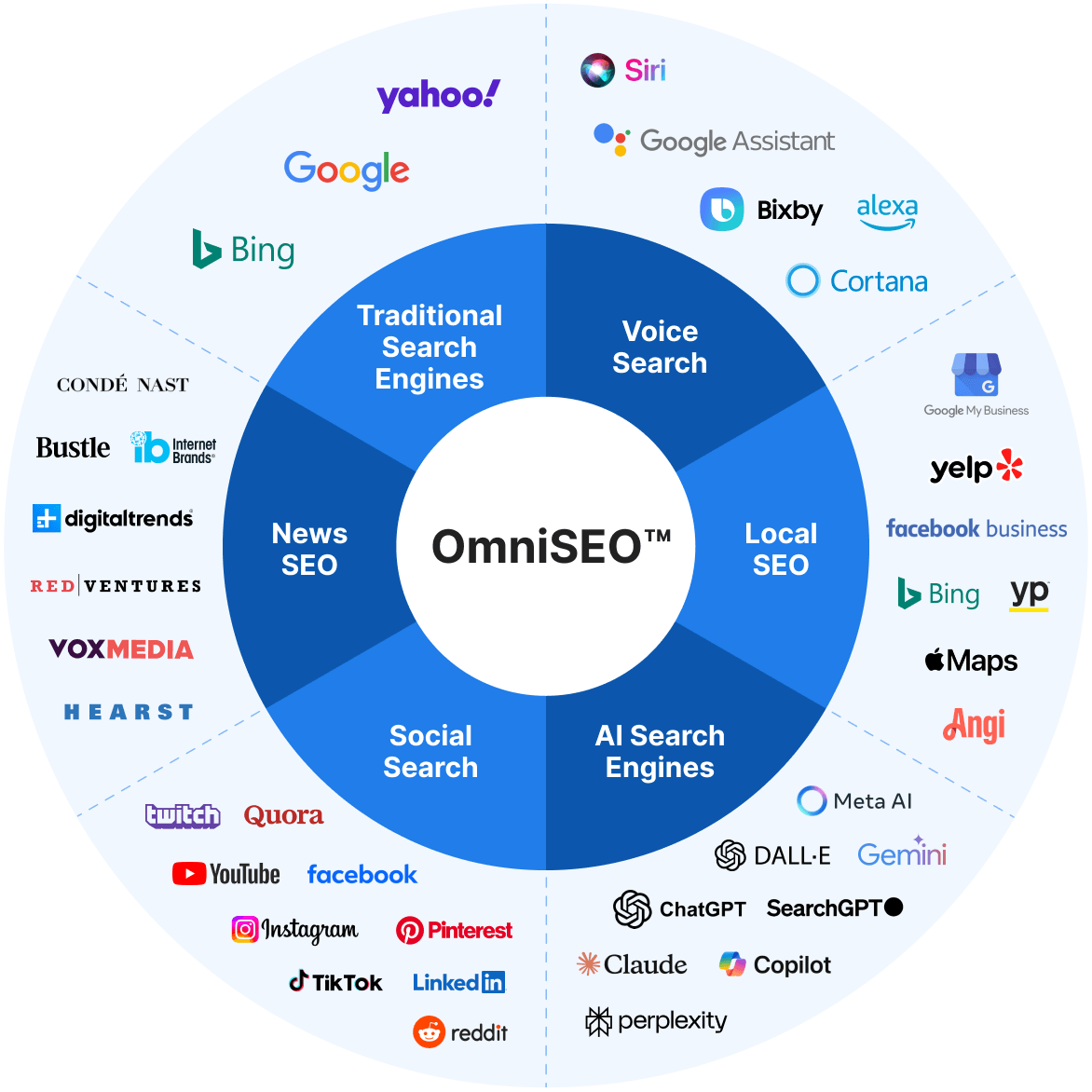
One of the most proactive steps marketers can take is adopting an OmniSEO approach to search. OmniSEO focuses on search everywhere optimization, which happens across:
- Traditional search engines
- Answer or AI search engines
- Social networks
- Voice assistants
You can see all the channels OmniSEO targets in the graphic below:
When it comes to the “how” of OmniSEO, there are a few focus areas:
| Focus area | How it works |
| SEO | Well-optimized sites are more likely to get mentioned or cited in AI-generated responses. That’s why businesses need to invest (or continue investing) in their site’s search optimization. |
| Content | Compelling content, whether due to data insights, first-hand perspectives, or useful tools, is more likely to appear in AI-generated answers. |
| Online reputation | Getting recognized across the web, whether through awards, best-of lists, or online mentions also build a brand’s reputation, authority, and trustworthiness within an AI model’s dataset. |
For ecommerce-specific stores, there is an additional optimization to focus on and that’s Google Shopping Graph, which powers AI Mode’s Shopping capabilities. You can join Google Merchant Center to enter it.
3. Adapting faster than the competition
No matter the market, from healthcare to ecommerce to hospitality, search is changing — in fact, these industries have seen the highest month-over-month growth in generative AI traffic.
Companies that prioritize OmniSEO (which includes optimizing for AI Mode) give themselves a competitive advantage. In comparison, late adopters place themselves in a tighter, more difficult position when it comes to growing their AI search visibility.
With rumors that Google could make AI Mode the default search experience, it’s imperative for companies to consider how — and where — they’ll get discovered online with their current marketing strategy.
Appear in Google AI Mode with OmniSEO experts
Start your journey to getting discovered in Google AI Mode and creating connections that drive revenue with the digital marketing agency that’s helped its clients appear in ChatGPT, Perplexity, Microsoft Copilot, and more.
Discover how our generative engine optimization services will grow your AI search visibility (and track it across 10 platforms) by contacting us today for a free proposal!